



Stainless-steel instruments are routinely used in foot care, podiatry and cosmetics. Long-term reliability depends on more than the original tool design. Appropriate cleaning, complete drying, careful inspection and organised storage all matter.
This guide explains common maintenance and storage mistakes. One key distinction is essential: cleaning, disinfection and sterilisation are separate procedures serving different purposes. Professional settings must follow the applicable hygiene requirements and each manufacturer's instructions.
Why stainless steel still requires care
Stainless steel is a suitable material for many professional instruments, but it is not immune to every environmental condition. Moisture, residues, unsuitable chemicals and contact with incompatible materials can affect surfaces. Inspecting instruments and storing them correctly should therefore be part of routine work.
Look at the instrument's actual construction as well as its material. Hinges, springs and fine tips deserve particular attention during cleaning and visual inspection.
Step 1: Organise used instruments immediately after work
The appropriate reprocessing route depends on intended use, the individual instrument, manufacturer approval and the workplace hygiene plan. Keep used items clearly separate from clean or already reprocessed tools. Placing everything together on a workstation makes this distinction harder to maintain.
For organising a work area, consider the stainless-steel kidney dish or the holder for double-ended instruments. These are organisational accessories, not replacements for validated reprocessing procedures.
Step 2: Check the manufacturer's instructions before selecting a cleaning agent
Suitable cleaning and disinfection methods cannot be determined from the word “stainless steel” alone. Hinges, coatings and other components may have special requirements. Cleaning products, concentrations, contact times and equipment must follow the respective manufacturer instructions.
Common mistake: using a stronger chemical than recommended
A higher concentration or a longer contact time does not automatically improve the result. Inappropriate products and processes can harm the instrument surface or components. Follow the approved procedure for both the tool and the chemical product.
Step 3: Dry completely and inspect carefully
After the required cleaning steps and any subsequent reprocessing, instruments should be thoroughly dry in accordance with the process instructions. Pay close attention to joints, inner surfaces, textured grips and delicate cutting edges.
Check for visible residue, changes in surface appearance and mechanical damage. An instrument whose functionality is uncertain should not be placed straight back into service.
Step 4: Do not confuse cleaning, disinfection and sterilisation
Cleaning removes soiling; disinfection serves another purpose, and sterilisation is a distinct process with its own requirements. Which stages are necessary depends on the intended use and applicable rules.
The fact that an instrument is made from stainless steel does not automatically mean it can undergo every cleaning or sterilisation process. Autoclave suitability must be documented for the individual product.
Where instruments require professional reprocessing, current requirements for hygiene, responsibilities, documentation and appropriate procedures must be observed. This article is not a substitute for a practice-specific standard operating procedure.
Step 5: Store instruments in a protected, orderly way
Depending on their intended use, clean and reprocessed instruments need dry, protected and clearly organised storage. Sharp cutting edges and delicate tips should not collide unnecessarily with other tools. Separation according to use and reprocessing status is an important part of practice organisation.
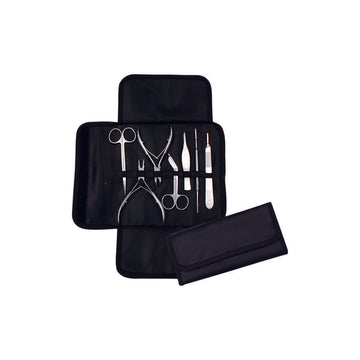
For transport and organised storage, the black instrument case for mobile foot care or the instrument case for up to 16 tools may be useful. Such cases are not automatically sterile packaging or approved for storing sterile medical devices.
For the reprocessing area, consider the stainless-steel sterilisation cassette for up to ten instruments. Whether and how it may be used in any process depends on its product specifications and the applicable requirements.
Seven common instrument-care mistakes
- Storing used and reprocessed instruments without clear separation.
- Using unverified cleaning or disinfecting agents.
- Changing processing steps without checking required contact times.
- Overlooking joints and textured grips during inspection.
- Putting away instruments while still damp.
- Leaving delicate cutting edges or tips unprotected.
- Treating cleaning, disinfection and sterilisation as interchangeable terms.
Daily practice checklist
- Are suitable manufacturer instructions available for each instrument?
- Are processing steps defined in the workplace hygiene plan?
- Are used and clean zones clearly separated?
- Is tool condition inspected regularly?
- Are appropriate trays and protective storage accessories available?
- Do staff understand which cases are simple transport aids and which containers are approved for particular processes?
Frequently asked questions
Can every stainless-steel instrument be autoclaved?
No. The manufacturer must confirm suitability for the particular product; the material name alone does not prove it.
Does a case replace cleaning and reprocessing?
No. A case helps organise and protect tools against mechanical damage but does not replace any required cleaning or processing step.
Why is thorough drying important?
Residual moisture can compromise appropriate storage. Drying should follow the established procedure for the instrument.
Conclusion: good instrument care starts with a defined process
There is no universal cleaning chemical that replaces a well-designed procedure. Manufacturer information, material compatibility and good practice organisation form the basis of responsible instrument care.
Explore useful practice accessories: Browse practice supplies and foot-care and beauty instruments. For a wider overview, read our guide to professional foot-care instruments.